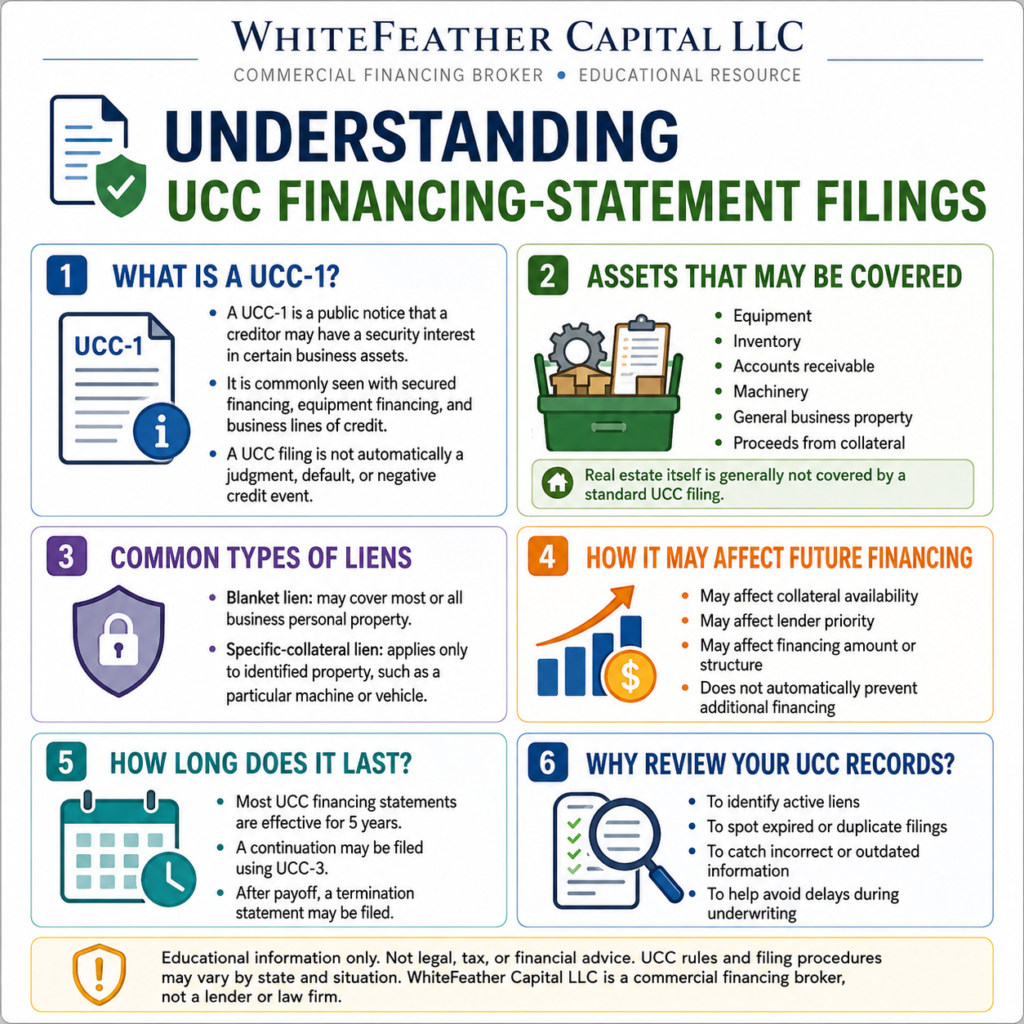
📘 Understanding UCC Financing-Statement Filings
📄 A UCC financing statement, commonly called a UCC-1, is a public notice showing that a creditor may have a security interest in certain business assets.
🏦 Businesses often encounter UCC filings when they obtain secured financing, equipment financing, a business line of credit, or another form of commercial funding.
🔍 What Does a UCC-1 Filing Mean?
📢 A UCC-1 tells other lenders, creditors, and interested parties that a creditor claims an interest in the collateral described in the filing.
📝 The filing itself does not create the security interest. The creditor’s rights generally arise from a separate security agreement between the business and the creditor. Filing the UCC-1 is commonly used to make that interest public and establish the creditor’s rights against certain third parties.
✅ A UCC filing is not automatically a judgment, default, collection action, or negative credit event. In many cases, it simply shows that the business has obtained secured financing.
🏭 What Business Assets May Be Covered?
📦 A UCC filing may cover business assets such as:
- 🛠️ Equipment
- 📦 Inventory
- 🧾 Accounts receivable
- ⚙️ Machinery
- 🏢 General business property
- 📈 Certain investment property
- 💰 Proceeds generated from collateral
- 🚚 Specific business vehicles, subject to applicable title laws
🏠 Real estate itself is generally not covered by a standard UCC financing statement. However, equipment, machinery, or other goods that are permanently attached to real property may be covered through a fixture filing.
🌐 Blanket Liens
🧺 A blanket lien may cover most or all of a business’s personal property.
📋 Depending on the financing agreement, a blanket lien may include:
- 💼 Current business assets
- 🔮 Future or after-acquired assets
- 📦 Inventory
- 🛠️ Equipment
- 🧾 Accounts receivable
- 💵 Proceeds from collateral
🏦 Blanket liens are often used in secured working-capital financing, business lines of credit, and other commercial financing arrangements.
🎯 Specific-Collateral Liens
🔒 A specific-collateral lien applies only to particular property identified in the financing documents.
⚙️ For example, an equipment-financing provider may claim a security interest in a specific machine, vehicle, or piece of equipment. The asset may be identified by its make, model, serial number, vehicle identification number, or another detailed description.
💳 How UCC Filings Affect Future Financing
✅ An active UCC filing does not automatically prevent a business from obtaining additional financing.
🔎 However, an existing filing may affect:
- 🏦 The type of financing available
- 💵 The amount a financing provider may offer
- 🔐 The collateral a new provider can use
- 📊 The provider’s underwriting or approval decision
- 🥇 The new provider’s lien-priority position
🤝 A new financing provider may agree to accept a second-position lien, use different collateral, require the existing obligation to be paid off, or request a subordination agreement from the existing secured creditor.
🥇 UCC Priority
⏱️ The general UCC priority rule is often described as first to file or perfect.
📌 This generally means that a creditor that properly files or otherwise perfects its security interest first may have priority over later creditors claiming an interest in the same collateral.
⚖️ Exceptions and special priority rules may apply depending on the type of collateral, transaction, and method of perfection. Certain purchase-money security interests and interests perfected through possession or control may receive special priority.
📅 How Long Does a UCC Filing Last?
🗓️ Most UCC financing statements are effective for five years, although different rules may apply to certain specialized transactions.
🔄 A creditor may extend the effectiveness of the filing by submitting a UCC-3 continuation statement, generally during the final six months before the existing filing expires. Additional continuation statements may be filed when permitted.
🛑 After the secured obligation has been satisfied, the creditor may file a UCC-3 termination statement. Businesses should review their public records to confirm that outdated filings have been properly terminated or have expired.
🔎 Why Businesses Should Review Their UCC Records
🧭 Business owners should periodically review UCC filings recorded under their company’s legal name and any relevant former names.
📋 A review may help identify:
- 🔒 Active liens
- ⌛ Expired filings
- 📑 Duplicate filings
- ✏️ Incorrect business information
- ✅ Filings connected to obligations that have already been paid
- 🚨 Unauthorized or unfamiliar filings
⚠️ An inaccurate, outdated, or unexpected UCC record may delay financing, create questions during underwriting, or affect the collateral available for a new financing transaction.
📚 What Does UCC Mean?
📘 UCC stands for the Uniform Commercial Code, a set of standardized state laws that governs many commercial transactions in the United States.
🏛️ The UCC addresses areas such as secured transactions, sales of goods, negotiable instruments, bank deposits and collections, letters of credit, and financing-statement filings.
🔐 In secured commercial financing, the UCC provides the legal framework for creating, perfecting, prioritizing, and publicly recording a creditor’s security interest in a business’s personal property.
⚠️ Educational Disclaimer
🎓 This information is provided for general educational purposes only. It is not legal, tax, accounting, credit, or financial advice and does not create an attorney-client, advisory, fiduciary, or other professional relationship.
🗺️ UCC rules, filing requirements, priority rights, termination procedures, and enforcement remedies may vary depending on the applicable state law, type of collateral, transaction documents, and specific circumstances.
👨⚖️ Business owners should consult qualified legal counsel regarding their individual situation, including questions about an existing filing, lien priority, collateral rights, termination, amendment, or dispute.